

Great Migration Masai Mara — The Ultimate Wildlife Spectacle Guide 2026
The great migration Masai Mara is the greatest wildlife event on earth — 1.5 million wildebeest, 300,000 zebra, and 200,000 gazelles thundering across the Mara River in scenes so dramatic they defy description. From July through October every year, Kenya’s Masai Mara National Reserve becomes the stage for nature’s most extraordinary performance, and no amount of documentary footage prepares you for witnessing it in person. If you have ever wondered whether the great migration Masai Mara lives up to its reputation — it does, and then some.
This guide covers everything you need to plan a great migration Masai Mara safari confidently: exactly when to go, the best crossing spots, how the Masai Mara great migration river crossing compares to the Serengeti, what a typical safari day looks like, photography strategy, and honest planning advice from a team that has operated migration safaris in the Mara for over a decade.
Whether this is your first Africa safari or your fifth, the great migration Masai Mara is the most important wildlife event you can witness as a human being on this planet. Every year, without fail, it delivers something new — a crossing of unusual scale, a lion pride ambush at the water’s edge, a crocodile battle over a wildebeest carcass — that no previous visit prepared you for.
🦬 Plan Your Great Migration Safari Today
Armani Tours and Travel specialises in great migration Masai Mara safaris — river crossing positioning, best camps, and expert guides who know every crossing point.
Free consultation · Expert river crossing positioning · Book 6–12 months ahead
Masai Mara Great Migration River Crossing
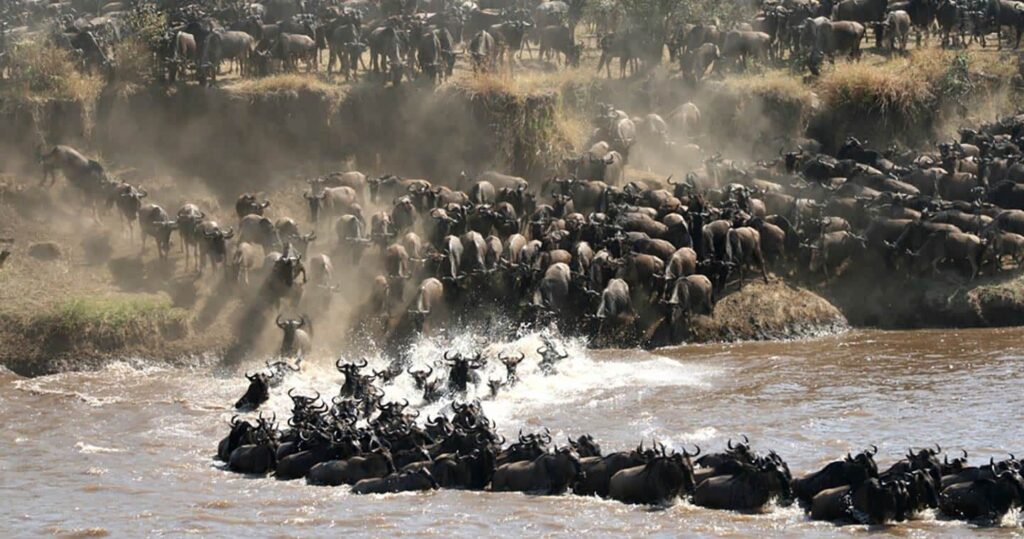
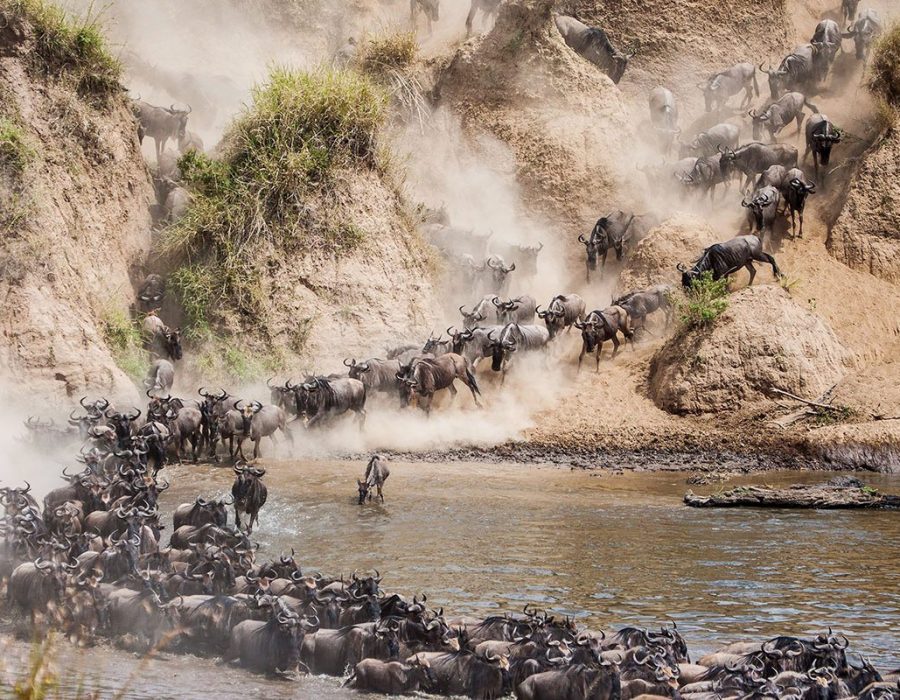
The Masai Mara great migration river crossing is the defining image of African wildlife — a wall of wildebeest, eyes wide with fear and instinct, plunging into the brown water of the Mara River as Nile crocodiles explode from the surface. Nothing in nature matches its raw, chaotic intensity. Understanding how and why these crossings happen is essential to positioning yourself to witness one.
The Mara River acts as the critical barrier between Tanzania’s Serengeti ecosystem and Kenya’s Masai Mara. The wildebeest must cross it twice annually — northward into Kenya from July onward, and southward back into Tanzania from October.
Each crossing is a separate biological gamble: crocodiles up to 5 metres long, powerful currents, and the crushing pressure of hundreds of thousands of animals following each other into the unknown. The spectacle is brutal, beautiful, and utterly captivating.

When Do the River Crossings Happen?
The Masai Mara great migration river crossing does not follow a fixed timetable — crossings are governed entirely by the behaviour of the wildebeest. The herds build at the river bank, sometimes for hours, before a single animal triggers the crossing. Every experienced guide in the Mara will tell you the same thing: you cannot predict a crossing, only maximise your chances of witnessing one.
- Late June–July: First wildebeest begin arriving at the Mara River from the Serengeti. Early, smaller crossings begin. Not guaranteed daily.
- August: Full herds present throughout the Mara Triangle. Multiple crossings per week, sometimes per day. Peak drama begins.
- September: The single best month. Herds concentrated, crossings frequent, crocodile activity at its most intense. Book first.
- October: Crossings continue but the herds begin moving south. Dramatic south-bound crossings also possible. Numbers thinning by late October.
- November: Most wildebeest have returned to the Serengeti. Occasional stragglers may cross but mass events are rare.
Best Spots to Watch the Masai Mara Great Migration River Crossing
The Mara River has several established crossing points where wildebeest repeatedly congregate. Knowing these locations — and being parked at the right one before the herds arrive — is what separates experienced migration guides from novices.
🏆 Lookout Hill / Mara Triangle — Primary Crossing Zone
The most reliable and most dramatic crossing location. Wide river bend with steep banks creates the classic image. Accessible from camps in the Mara Triangle. Often has multiple crossing events in August–September.
📍 Governors Camp Crossing Point
Adjacent to Governors Camp on the main Masai Mara Reserve side. One of the most photographed crossings in Africa. Camp position gives guests first access every morning.
📍 Serena Crossing — Mara Triangle
Located near Mara Serena Lodge on the western Mara Triangle side. Dramatic location with high banks providing excellent elevated viewing angles. Good vehicle access.
📍 Purungat Bridge Area
Northern section of the Mara River. Less visited than the main crossing zones. Can deliver exceptional uncrowded experiences when crossings occur here during peak season.
📍 Sand River — Southern Mara
Where the Sand River meets the Mara, near the Tanzania border. Crossings here happen early in the migration season (July). Good for early-season visitors wanting first crossing opportunities.
What Makes the River Crossing So Spectacular?
The great migration Masai Mara river crossing generates its intensity from multiple simultaneous forces all reaching peak energy in a single moment:
- 🦬 Sheer numbers: A single crossing can involve 5,000 to 50,000 animals entering the water simultaneously — the sound of hooves on the bank is audible from a kilometre away
- 🐊 Nile crocodiles: The Mara River contains one of the world’s densest Nile crocodile populations — up to 3,000 crocodiles in the river system, many exceeding 4 metres in length
- 🦁 Predator concentration: Lion prides, leopards, cheetahs, and hyenas all position themselves near crossing points — the chaos creates unprecedented hunting opportunities
- 🌊 The river itself: Strong currents, submerged rocks, and steep exit banks claim animals even without predator involvement — the river is a genuine obstacle in its own right
- 🔄 Unpredictability: A massive herd can build for three hours then suddenly turn and retreat. When they finally cross, it happens with explosive, terrifying speed
“I have witnessed over 200 Mara River crossings in 11 years of guiding. No two are identical. No amount of preparation makes you ready for the first one. The scale of the great migration in Masai Mara physically overwhelms experienced travellers every single time.”
— Senior Safari Guide, Armani Tours and Travel, Masai Mara Field OperationsThe Biology Behind the Great Migration Masai Mara
The great migration Masai Mara is not a random animal movement — it is one of the most precisely calibrated biological events in the natural world, driven by rainfall, grass growth, and instinct honed over hundreds of thousands of years. Understanding the mechanics behind the migration deepens every crossing moment you witness.
The wildebeest follow the rains. As the long rains end in Tanzania’s southern Serengeti around March, the short grass plains dry out and the herds begin moving north and west following new grass growth. By July, the grass in Kenya’s Masai Mara — freshened by the long rains — draws the herds north across the Mara River.
The migration is essentially a giant, self-regulating grazing machine: 1.5 million mouths following a wave of protein-rich grass around a 1,800-kilometre circuit every year.
The crossing itself is triggered by a phenomenon called “swarm intelligence” — no single wildebeest leads the herd. Instead, the decision to cross emerges spontaneously from the collective behaviour of thousands of animals simultaneously processing information about water depth, crocodile proximity, bank slope, and herd density.
Scientists at the Maasai Mara Trust and Kenya Wildlife Service have documented that crossings can be triggered when the herd density at the bank exceeds a critical threshold — after which the movement becomes unstoppable.
Migration Biology Key Facts
- Annual distance: Each wildebeest travels approximately 800–1,000 km one way — 1,600–1,800 km round trip per year
- Calving synchrony: 80% of all wildebeest calves are born within a 3-week window in the southern Serengeti (January–February), overwhelming predator capacity
- Weight loss: Wildebeest lose up to 20% of their body weight during the migration north — they arrive at the Mara lean and urgently hungry
- Mortality rate: Approximately 250,000 wildebeest die annually from predation, drowning, exhaustion, and starvation — making the migration a net zero population event in equilibrium
- Crocodile memory: Mara River Nile crocodiles have been documented repeatedly returning to the same crossing points year after year — they learn migration patterns across decades
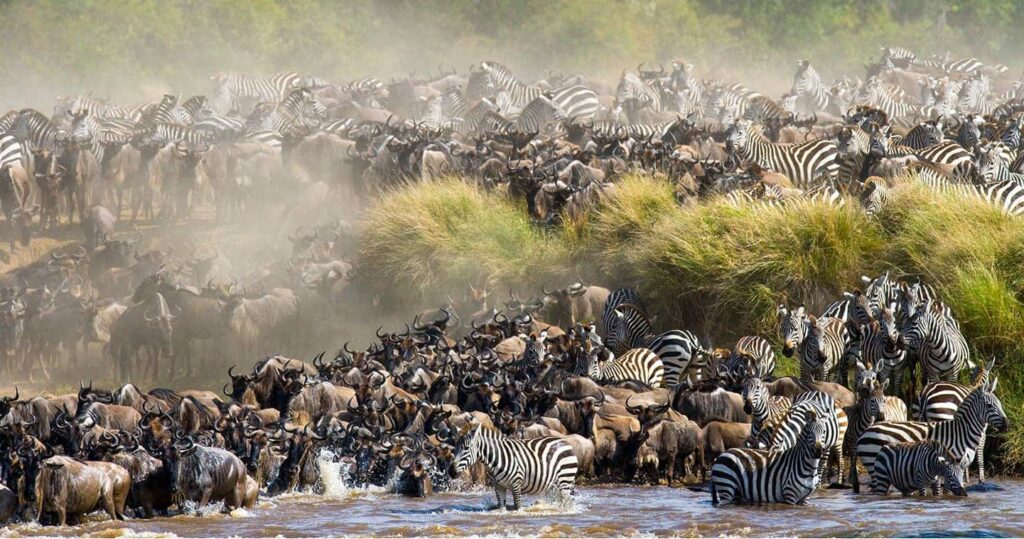
- Zebra vanguard: Zebra consistently arrive at crossing points before wildebeest, crossing first and reducing risk for the larger herd — a documented co-evolutionary partnership
Best Time to See the Great Migration in Masai Mara
The best time to see great migration in Masai Mara is July through October, with August and September delivering the highest crossing frequency and the greatest concentration of wildebeest within the reserve. However, the right month for your safari depends on more than just crossing probability — budget, crowd tolerance, and what other wildlife experiences you want will all influence your decision.
Peak Season vs Low Season — What to Expect
✅ Peak Season (Jul–Oct) — Why It Wins
- River crossings at maximum frequency
- All 1.5 million wildebeest present in Mara
- Highest predator activity — lions hunting daily
- Dry conditions — easy game drive roads
- Clear skies — best photography light
- Full camp staff and guide availability
⚠️ Peak Season Considerations
- 30–50% higher camp prices vs low season
- Multiple vehicles at river crossings during busy days
- Must book 6–12 months in advance
- Cold mornings at dawn (7–12°C) — bring layers
- September crossing vehicles can be busy at popular points
Outside the main migration window, the Masai Mara still delivers outstanding wildlife but without the river crossing spectacle. January and February bring excellent resident wildlife with fewer tourists and 30–40% lower prices. The green season (April–May) offers the lowest prices and beautiful landscapes but with the wettest conditions.
How Far in Advance Should You Book?
For the great migration Masai Mara peak season (July–October), you should book your safari at least 6 months ahead and ideally 9–12 months ahead for August and September. The best camps — Governors Camp, Rekero, Little Governors, Mara Toto — are routinely sold out 12 months before peak season dates. Mid-range camps should be secured 4–6 months ahead. Waiting until 1–3 months before departure almost always means settling for second-choice properties at inflated last-minute prices.
- August–September dates: Book 9–12 months ahead for preferred camps
- July and October dates: Book 6–9 months ahead
- November–June dates: Book 3–4 months ahead
- December holidays and Easter: Book 6–9 months ahead regardless of migration
Month-by-Month Great Migration Calendar
The great migration Masai Mara is part of a year-round circular movement across 1,800 kilometres. Understanding the full annual great migration Masai Mara calendar helps you choose the right month and set accurate expectations for what you will see when you arrive. The great migration Masai Mara is not isolated — it is one chapter of a remarkable year-round story that spans two countries and 40,000 square kilometres of wilderness.
| Month | Migration Location | Key Event | Masai Mara Crossings? | Visitor Rating |
|---|---|---|---|---|
| January | Southern Serengeti | Calving Season Begins | No | ⭐⭐⭐ (other wildlife) |
| February | Southern Serengeti | Peak Calving — 500,000 calves in 3 weeks | No | ⭐⭐⭐⭐ (calving) |
| March | Central Serengeti | Herds Moving North | No | ⭐⭐⭐ |
| April | Central Serengeti | Long Rains Begin — Herds Dispersed | No | ⭐⭐ (wet season) |
| May | Western Serengeti | Grumeti River Crossings Begin | No | ⭐⭐⭐ |
| June | Western Serengeti / Northern Serengeti | First Mara Crossings Possible | Early/Occasional | ⭐⭐⭐⭐ |
| July | Masai Mara | Peak Crossings Begin — Great Migration Arrives | ✅ Regular | ⭐⭐⭐⭐⭐ |
| August | Masai Mara | Maximum Herd Numbers — Peak Drama | ✅ Most Frequent | ⭐⭐⭐⭐⭐ |
| September | Masai Mara | Dramatic Crossings Continue | ✅ Very Frequent | ⭐⭐⭐⭐⭐ |
| October | Southern Masai Mara | Return Crossing South Begins | ✅ Tapering | ⭐⭐⭐⭐ |
| November | Northern Serengeti | Herds Moving South — Short Rains | Occasional | ⭐⭐⭐ |
| December | Southern Serengeti | Herds Arrive Serengeti for Calving | No | ⭐⭐⭐ |
Great Migration Masai Mara — Pre-Safari Planning Checklist
Clients who arrive at the great migration Masai Mara well-prepared have consistently better experiences than those who leave logistics to chance. This is the preparation checklist our team sends to every migration safari client 8 weeks before departure.
- ✅ Visa secured: Kenya eTA available online at etakenya.go.ke. Apply minimum 2 weeks before travel. Required for most nationalities.
- ✅ Vaccinations confirmed: Yellow fever certificate required for Kenya. Hepatitis A, typhoid, and malaria prophylaxis recommended. Consult a travel health clinic 6 weeks before departure.
- ✅ Travel insurance arranged: Ensure your policy covers medical evacuation from remote areas — standard in the Masai Mara. Confirm wildlife safari activities are included.
- ✅ Camera equipment packed: Sensor-cleaned camera body (dust is significant), primary zoom lens (100–400mm), spare batteries (cold mornings drain fast), large memory cards, dust-proof bag.
- ✅ Clothing prepared: Neutral colours (khaki, olive, tan — avoid white and blue). Layers essential — Mara mornings (07:00) can be 7–12°C in August. Lightweight afternoon options for 25–30°C midday.
- ✅ Binoculars packed: Quality 8×42 or 10×42 — your own pair makes a significant difference to crossing observation quality.
- ✅ Charter flights confirmed: Wilson Airport (Nairobi) to Mara airstrip. Confirm weight allowance — most charter flights allow 15kg including hand luggage in soft-sided bags only.
- ✅ Camp briefed on dietary needs: Inform your camp in advance of any dietary requirements — most camps cater comprehensively but appreciate advance notice.
- ✅ River scout contact: Ask your guide to share the river scout network contact — so you receive crossing alerts even during rest hours at camp.
- ✅ Cash for tips and extras: Carry USD cash for guide tips ($15–25 per person per day), camp staff gratuities ($5–10), balloon flights ($450–500 pp), and any personal purchases.
Great Migration Masai Mara vs Serengeti
The great migration Masai Mara vs Serengeti debate is the most common question we receive from clients planning their first Africa wildlife safari. Both destinations host the same 1.5 million wildebeest — the difference is timing, crossing drama, and the overall safari experience. Here is an honest, experience-based comparison from a decade of operating great migration Masai Mara and Serengeti safaris across both ecosystems.
Key Differences Between Masai Mara and Serengeti
| Factor | Masai Mara — Kenya | Serengeti — Tanzania |
|---|---|---|
| Best Migration Months | July — October | November — June (varies by zone) |
| River Crossings | 🏆 Mara River — Most Dramatic | Grumeti River — Less Intense |
| Crossing Frequency | Multiple crossings per week (Aug–Sep) | Less frequent, shorter duration |
| Crocodile Numbers | 3,000+ in river system | Fewer at Grumeti crossings |
| Park Area | 1,510 km² National Reserve | 14,763 km² National Park |
| Flight Access | Via Nairobi (45–90 min flight to Mara) | Via Kilimanjaro / Arusha (1–2 hr flight) |
| Park Fees | From $80 per person/day | From $70 per person/day (Serengeti) |
| Accommodation Range | Budget to ultra-luxury | Budget to ultra-luxury |
| Crowd Levels | Moderate — concentrated crossing areas | Lower density — vast park size |
| Calving Season | Not present (Jan–Feb in Serengeti) | Jan–Feb Southern Serengeti |
| Combined Trip | ✅ Yes — 7–14 day circuit possible | ✅ Yes — 7–14 day circuit possible |
| Best For | 🏆 River crossing spectacle | Full migration annual circuit |
Which Destination Offers the Best Migration Experience?
For the great migration Masai Mara safari experience specifically seeking river crossings, the Masai Mara is objectively the superior choice. The Mara River crossings are more dramatic, more frequent, and more consistently accessible than the Grumeti crossings in western Tanzania. The Mara’s resident crocodile population — one of the largest in Africa — adds a level of predatory intensity the Grumeti crossings rarely match.
The Serengeti wins on duration: migration animals are present in different zones of the Serengeti for up to 8–9 months of the year, compared to 3–4 months in the Masai Mara. For the calving season — 500,000 wildebeest calves born in just three weeks across the southern Serengeti plains in January and February — there is no comparison. The Serengeti is the only place on earth to witness it.
For sheer crossing drama and concentrated impact in a single trip, the great migration Masai Mara is the winner. For the full annual migration story, combine both destinations.
Can You See Both in One Trip?
Yes — a combined great migration Masai Mara vs Serengeti safari is entirely achievable in 10–14 days and is one of the most popular itineraries Armani Tours and Travel designs. The most common approach pairs 5–7 days in the Masai Mara (July–October for crossings) with 4–5 days in the northern Serengeti, connecting via a short charter flight from the Mara airstrip.
Great Migration Masai Mara Safari Experience
A great migration Masai Mara safari experience is not simply about the river crossings — it is about immersing yourself in an ecosystem that has hosted this annual event for over a million years. From the moment your bush plane drops onto the Mara airstrip and you see your first dust cloud of wildebeest from the air, every element of the experience is calibrated by nature to overwhelm your senses.
What Animals Are Part of the Great Migration?
The great migration Masai Mara involves far more species than just wildebeest. The full cast of characters that makes the great migration Masai Mara ecosystem so extraordinary during peak season:
| Animal | Numbers in Migration | Role | Best Viewed |
|---|---|---|---|
| 🦬 Blue Wildebeest | 1.5 million | Primary migration species | All migration months |
| 🦓 Burchell’s Zebra | 300,000 | Travel ahead of wildebeest — eat long grass | June–November |
| 🦌 Thomson’s Gazelle | 200,000 | Follow migration — eat short grass behind herds | July–October |
| 🐊 Nile Crocodile | 3,000+ (Mara River) | Apex predator at river crossings | Jul–Oct crossings |
| 🦁 Lion | Large resident prides | Hunt wildebeest and zebra throughout migration | Year-round; peak Jul–Oct |
| 🐆 Cheetah | Resident population | Prey on calves and gazelles on open plains | Year-round |
| 🐻 Spotted Hyena | Clan groups | Scavenge and hunt migration animals | Jul–Oct most active |
| 🦅 Vultures | Thousands | Follow migration — clean up after crossings | Peak during crossings |

What a Typical Migration Safari Day Looks Like
Understanding the rhythm of a great migration Masai Mara safari experience day helps you maximise every hour in the field. This is a typical peak-season day from an Armani Tours-operated camp:
Pre-Dawn Wake Call
Hot tea and coffee served at your tent before first light. The Mara is coldest at this hour (7–12°C in August) — layers are essential. Your guide pre-reads overnight scout reports from the river crossing points and plans your first drive destination.
Morning Game Drive — River Positioning
Departure before sunrise to reach crossing points ahead of the herds. The critical window: wildebeest typically build at river banks between 07:00 and 11:00. Your guide positions the vehicle at the optimal vantage point and waits. This requires patience — some of the most extraordinary crossings are preceded by 2–3 hours of the herd pacing and retreating.
Bush Breakfast
If no crossing has begun, your guide serves a bush breakfast from the vehicle — proper Kenyan breakfast with fresh coffee under an acacia tree, surrounded by wildebeest as far as the eye can see. If a crossing begins, breakfast waits.
Continued Crossing Watch or Plains Game Drive
If the herds are still building at the bank, you stay and wait. If they have retreated, you pivot to a plains game drive — hunting lions, resident leopards in riverine trees, or cheetahs on the open grassland with cubs. The Mara’s resident wildlife is world-class even without the migration.
Return to Camp — Lunch and Rest
Back to camp for full lunch and afternoon rest during the hottest hours (12:30–15:30). Debrief with your guide. Review morning photographs. Plan afternoon strategy based on scout reports from the river.
Afternoon Game Drive
Second session targeting the golden hours of 16:00–18:30 — the best light for photography and peak predator activity. Lions, leopards, and cheetahs are most active in the late afternoon. Crossings also happen during afternoon hours, particularly on very hot days when the heat makes the herds restless.
Sundowner and Return to Camp
Sunset drinks in the bush — G&T or soft drinks — before the final drive home under fading light. Dinner at camp, guide debrief, and tomorrow’s plan. Repeat for 3–5 days to maximise crossing probability.
Photography Tips for the Great Migration
The great migration Masai Mara is one of the most photographed wildlife events on earth and still one of the most technically challenging to shoot well. The combination of fast-moving subjects, dramatic light changes, and high emotional intensity creates conditions that test even experienced wildlife photographers. These recommendations come from a decade of accompanying photographers to Mara River crossing points.
Camera Settings for River Crossings
- Shutter speed: Minimum 1/1000s to freeze wildebeest motion. Use 1/2000s+ for sharp individual animals mid-leap
- Aperture: f/5.6–f/8 for depth of field that keeps multiple crossing animals sharp
- ISO: Don’t fear ISO 800–3200 in early morning crossing light — modern cameras handle it cleanly
- Continuous autofocus: Use AI-Servo (Canon) or AF-C (Nikon/Sony) throughout. Crossings move fast and unpredictably
- Burst mode: Shoot in high-speed burst — crossings produce key moments in fractions of a second
- White balance: Set manually to Cloudy or Shade for warmer, more accurate morning light rendition
Lens Recommendations
- Primary: 100–400mm or 200–600mm zoom — flexible for wide herd shots and individual animal portraits
- Secondary: 70–200mm for contextual landscape shots with herd in foreground
- Wide angle: 24–70mm for environmental shots at the riverbank with dust clouds and scale context
- Teleconverter: 1.4x or 1.7x on longer lenses for crocodile attack close-ups from vehicle distance
Position and Timing Strategy
- Arrive early: Position your vehicle at crossing points before 07:00. The best light and the best positions go first
- Sun direction: Position with sun behind or at 90 degrees to your shooting angle — avoid shooting into the sun during crossings
- Height matters: Ask your guide to position on slightly elevated ground — elevation separates foreground animals from the mass behind them
- Horizontal vs vertical: Shoot horizontal for landscape impact shots, vertical for individual animals mid-leap — have two camera bodies ready or use portrait grip
- Patience is the technique: Great migration photography is 90% waiting and 10% execution. The photographers who leave early miss the shot
Where to Stay for the Great Migration Masai Mara
Your accommodation choice for the great migration Masai Mara determines everything — how quickly you reach crossing points, how good your guide is, and whether you spend your mornings at the river or stuck in a 2-hour drive to get there. Location is everything for a great migration Masai Mara safari experience.
The Masai Mara is divided into two main management zones: the main Masai Mara National Reserve (administered by Narok County Council) and the private conservancies that surround the reserve’s boundaries. For the great migration Masai Mara river crossing specifically, the Mara Triangle — the western section of the reserve across the Mara River — offers the closest proximity to the primary crossing zones.
Best Camp Zones for the Great Migration
🏆 Zone 1 — Mara Triangle (River Crossing Epicentre)
The Mara Triangle is the most sought-after great migration Masai Mara accommodation zone. Positioned west of the Mara River, camps here have exclusive access to the widest section of the river where the most dramatic crossings occur. The Triangle is managed separately from the main reserve by the Mara Conservancy — resulting in better road maintenance, stricter vehicle limits, and superior wildlife density. Recommended camps: Mara Serena Lodge, Sanctuary Olonana, Mara Toto Bush Camp.
🥈 Zone 2 — Governors Camp Area (Main Reserve, Mara River)
Governors Camp sits directly on the Mara River’s eastern bank in the main reserve — arguably the single best-positioned camp for great migration Masai Mara river crossing access. The camp’s river scouts report crossing activity in real time, and vehicles can be at the water’s edge within minutes of a crossing beginning. Governors Il Moran (adjacent private camp) offers the same river access at a higher service level.
🥉 Zone 3 — Olare Motorogi Conservancy
North of the main reserve, Olare Motorogi offers the great migration Masai Mara experience with the added benefit of night drives and walking safaris — not permitted inside the national reserve. Camps here access the same migration herds as the main reserve during peak season, with lower vehicle density and more exclusive game drive experiences. Recommended camps: Rekero Camp, Olare Mara Kempinski, Kicheche Mara Camp.
📍 Zone 4 — Mara North Conservancy
Adjacent to the reserve’s northern boundary, Mara North hosts excellent great migration Masai Mara wildlife viewing as herds move through the area in their July–October circuit. Lower prices than the main reserve, night drives permitted, and some of the most secluded camp settings in the Mara ecosystem. Recommended: Elephant Pepper Camp, Offbeat Mara Camp.
Great Migration Camp Budget Guide
| Budget Tier | Cost Per Person / Night | Camp Examples | Migration Access | What’s Included |
|---|---|---|---|---|
| Economy / Budget | $80–$150 | Mara Simba Lodge, Sekenani Camp | Good (longer drives) | Meals, game drives, shared bath |
| Mid-Range | $180–$380 | Basecamp Masai Mara, Mara Sopa | Very Good | All meals, 2 drives/day, en suite |
| Luxury | $380–$750 | Governors Camp, Sanctuary Olonana | Excellent (river adjacent) | All inclusive, private vehicle option |
| Superior Luxury | $750–$2,500+ | Governors Il Moran, Rekero Camp | 🏆 Best (on Mara River) | Fully all-inclusive, private vehicle, expert guide |
* Park fees ($80/person/day in main reserve) charged additionally at most camps. Conservancy fees included at conservancy camps. Armani Tours quotes include all applicable fees transparently.
Inside Reserve vs Private Conservancy for Great Migration
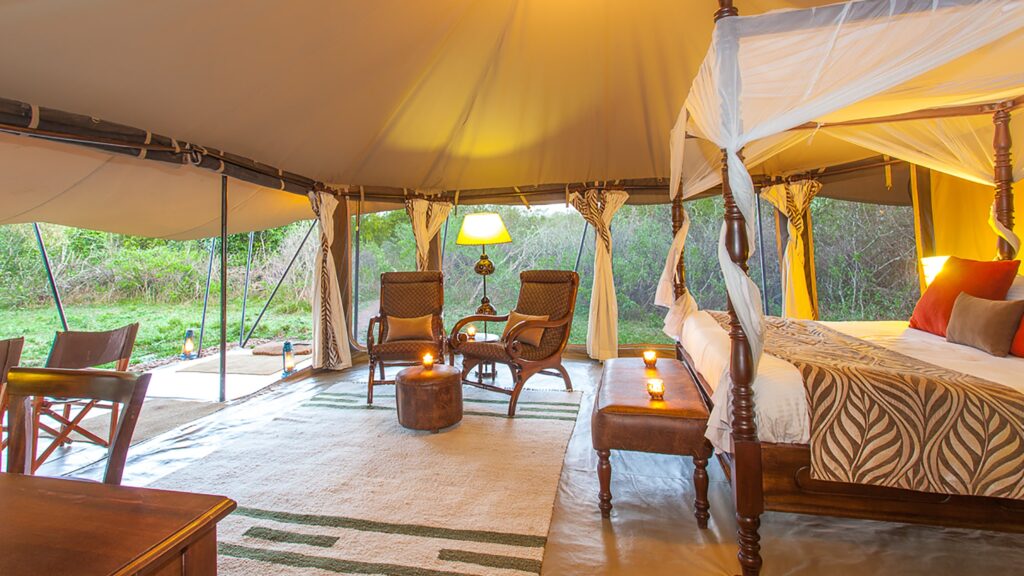
For the great migration Masai Mara specifically, camps inside the national reserve — particularly along the Mara River — have a timing advantage: they can reach crossing points faster. However, private conservancy camps (Olare Motorogi, Mara North) offer night drives and walking safaris that enhance the overall great migration Masai Mara safari experience significantly.
Many experienced visitors split their stay: 3 nights in a river-adjacent camp inside the reserve during peak crossing season, then 2 nights in a conservancy for night drive experiences.
- Inside the reserve: Fastest crossing access, 24/7 wildlife proximity, no night drives, busier vehicle numbers
- Conservancy camps: Night drives and walks permitted, lower vehicle density, more exclusive, same migration herds
- Split stay: Best of both worlds for 7+ night great migration Masai Mara safaris
How to Plan Your Great Migration Masai Mara Safari
Planning a successful great migration Masai Mara safari requires attention to timing, camp selection, duration, and logistics — more so than almost any other safari destination because the crossing window is finite and the best camps fill many months ahead. Here is the exact planning sequence we follow with every client at Armani Tours and Travel.
10 Expert Tips for the Great Migration Masai Mara
These are the practical, unfiltered recommendations from Armani Tours guides who have spent years positioning clients at the great migration Masai Mara river crossings. Apply them and your safari probability of witnessing a crossing increases dramatically.
| # | Expert Tip | Why It Matters |
|---|---|---|
| 1 | Leave camp by 05:45 — before sunrise | The best crossing positions are claimed in the first hour of light. Late arrivals find other vehicles already positioned |
| 2 | Choose a guide, not just a camp | An experienced great migration Masai Mara guide who reads wildebeest herd behaviour will consistently outperform the best-positioned camp served by a mediocre guide |
| 3 | Stay minimum 3 nights in the Mara Triangle | Crossing probability on any single day is roughly 40–60% in August–September. Three days gives you 87–94% cumulative probability |
| 4 | Do not panic when the herd retreats | Wildebeest retreating from the bank is normal. They often try 2–4 times before crossing. Stay positioned and wait |
| 5 | Keep your camera in burst mode all day | Great migration Masai Mara crossings can start with no warning. If your camera is off or in single-shot mode, you will miss the action |
| 6 | Silence in the vehicle near crossing herds | Wildebeest are highly sensitive to unfamiliar sounds. Loud voices or music near a building herd can trigger a retreat before the crossing begins |
| 7 | Request the camp’s river scout WhatsApp group | The Mara has an informal but highly effective scout communication network — crossing alerts are shared in real time. Your guide should have access |
| 8 | Book a hot air balloon for your penultimate morning | If you witness a crossing on day 2, the balloon flight on day 4 lets you see the same landscape from above — a breathtaking contrast. Do not balloon first — save it as a reward |
| 9 | Expect dust — protect your gear | August–September Mara drives generate significant fine dust. Bring a sealed dry bag for camera equipment. Clean your sensor every morning before first drive |
| 10 | Allow contingency in your schedule | Great migration Masai Mara charter flights are weather-dependent. Build 1 extra night’s flexibility before any international connection. Delays are rare but not unknown |
Fix Your Travel Dates Around Migration Timing
The crossing window for the great migration Masai Mara is July–October. August and September are the peak months. If your travel dates are fixed and fall outside this window, adjust expectations accordingly — the Masai Mara is still exceptional for Big Five but without river crossings. If your dates are flexible, build the migration window first and construct the rest of your trip around it.
Choose the Right Camp Location
For the greatest migration Masai Mara river crossing experience, prioritise camps inside the Mara Triangle or directly adjacent to the main Mara River crossing zones. Governors Camp, Governors Il Moran, Rekero Camp, Little Governors, and Mara Toto are the highest-proximity options. Camps further east (Sekenani or Talek zones) require longer drives to reach crossing points and will deliver crossings less reliably.
Allow Minimum 3 Full Days at the River
The single most important planning decision for the great migration Masai Mara. Crossings cannot be guaranteed on any specific day. A 3-night minimum gives you 6 game drives at the river — sufficient to encounter at least one crossing in August or September under normal conditions. 4–5 nights is the expert recommendation for high probability.
Book 6–12 Months Ahead
The best great migration Masai Mara camps sell out quickly. Governors Camp and Rekero Camp are frequently full 12 months before August and September dates. Mid-range options need 4–6 months lead time. Armani Tours and Travel has preferred allocation agreements with key camps — contact us as early as possible for the best availability.
Arrange Internal Flights — Not Road Transfers
The drive from Nairobi to the Masai Mara takes 5–6 hours each way on variable road conditions. For a great migration safari, use charter flights from Wilson Airport in Nairobi to the Mara airstrips (45–60 minutes). You arrive fresh, maximise your game drive time, and avoid the physical toll of long road transfers. Charter flights cost $200–$350 per person each way.
Request a Dedicated Migration Guide
Not all Masai Mara guides have equal crossing experience. When booking your great migration Masai Mara safari through Armani Tours, we specifically request guides with crossing expertise — those who read herd behaviour, know which banks the wildebeest favour in which conditions, and have established relationships with river scouts who radio crossing alerts across the reserve.
Consider Adding Tanzania — Serengeti or Ngorongoro
Many clients extend their great migration Masai Mara safari with 3–5 days in Tanzania — either the northern Serengeti (for more migration habitat) or Ngorongoro Crater (for the most concentrated Big Five viewing in Africa). Armani Tours and Travel designs seamless Kenya–Tanzania combination safaris with all cross-border logistics handled.
🦬 Book Your Great Migration Masai Mara Safari
Armani Tours and Travel has operated great migration Masai Mara safaris for over a decade. We secure preferred camp allocations 12 months ahead, position you at the right crossing points, and assign guides who know the Mara River crossings better than anyone.
📧 [email protected] · +254 722534853 · Free consultation · Trusted since 2012
Why Book Your Great Migration Masai Mara Safari with Armani Tours
Hundreds of tour operators offer great migration Masai Mara safaris. What separates Armani Tours and Travel from the rest is not marketing language — it is operational experience and measurable differences in what clients actually experience in the field.
What Armani Tours Delivers Differently
- 🦬 Preferred camp allocations: We hold allocation agreements with Governors Camp, Rekero, Mara Toto, and Olare Mara Kempinski — guaranteed access to the highest-priority great migration Masai Mara properties even in peak season.
- 🌊 River scout network access: Our guides operate within the Mara’s real-time crossing alert system. When a major crossing begins, our clients are repositioned within minutes — not hours.
- 📸 Photography-focused positioning: We understand crossing photography and position vehicles for optimal light angle, elevation, and sight line — not just proximity. The difference between good migration photos and extraordinary ones is often vehicle placement.
- 📅 12-month advance planning: For peak season great migration Masai Mara dates, we advise booking 9–12 months ahead. We secure your camp before availability tightens and prices spike.
- 🔄 Full Kenya–Tanzania integration: Armani Tours designs seamless great migration Masai Mara and Serengeti combination safaris with all cross-border logistics — visas, flights, transfers — handled as a single package.
- 🎯 Expert guide assignment: We specifically request guides with documented crossing experience for great migration Masai Mara clients — not generalist guides covering the full park circuit.
Every great migration Masai Mara safari we design is custom-built — no template packages, no group tours with strangers, no compromises on guide quality or camp location. You travel with private vehicles, experienced naturalist guides, and the full support of a team that knows the Mara River crossing system better than any other operator we are aware of.
Our great migration Masai Mara clients return at a higher rate than any other great migration Masai Mara safari type we operate. When you witness a crossing, you understand why. The experience does not diminish in memory — it deepens. Many of our most loyal clients have now witnessed the great migration Masai Mara four, five, or six times, returning each year because no crossing is ever the same, and no experience in Africa competes with what the Mara River delivers in August and September.
The Great Migration Masai Mara — A Wildlife Experience Like No Other
The great migration Masai Mara is not a wildlife event you simply observe — it is one you absorb, feel, and carry with you long after you leave. The thunder of 50,000 wildebeest hitting the Mara River simultaneously — a sound that carries across the plain and raises every hair on your arms before you even see the crossing. The great migration Masai Mara does not deliver its impact gradually. It arrives all at once, fully formed, and overwhelming.
The explosive eruption of a 4-metre crocodile from the surface. The desperate scramble of animals pulling themselves up a muddy bank on the far side. The silence of the plains immediately after a crossing — broken only by the calls of vultures descending. These are not scenes from a documentary. They are real, immediate, and available to any traveller willing to plan carefully and commit the time to witness them.
The great migration Masai Mara succeeds as a safari destination because it delivers on multiple levels simultaneously. The crossings themselves are the headline, but surrounding them is the Mara’s extraordinary year-round wildlife — one of Africa’s densest lion populations, resident leopards, cheetahs with cubs on the open plains, elephant family groups at the river, and the richest concentration of bird species in East Africa.
Add private conservancies offering night drives and walking safaris, bush breakfasts under fever trees, and the remarkable Maasai culture present in and around the reserve, and the great migration Masai Mara delivers a complete Africa experience that rivals any destination on the continent.
Plan early for your great migration Masai Mara safari. Choose your camp based on river proximity. Allow at least 3–5 days for crossing probability. Use a guide who has spent years at the Mara River reading the herds. And trust that when your crossing finally happens — as it almost certainly will — you will understand immediately why the great migration Masai Mara sits at the very top of every serious wildlife traveller’s list.
Beyond the crossings, the great migration Masai Mara season delivers unparalleled predator viewing, extraordinary bird life, and the profound experience of witnessing an ecosystem operating at full evolutionary capacity. The lion prides that line the river banks during crossing season have been hunting wildebeest in this location for generations. The crocodiles have been present since long before the first human set eyes on the Mara.
When you sit at the bank and watch 30,000 wildebeest enter the water, you are not watching a tourist attraction — you are watching 500,000 years of co-evolution play out in front of you in real time. That context transforms a spectacular wildlife event into something approaching a spiritual experience.
Practical preparation matters enormously for the great migration Masai Mara — but so does arriving with the right mindset. A great migration Masai Mara safari is not an event you control or schedule. You show up, you position yourself well, you wait, and you trust that nature will deliver.
It almost always does for great migration Masai Mara visitors. In over a decade of operating migration safaris, fewer than 3% of our clients have failed to witness at least one Mara River crossing — and every single one of those clients returned the following year. The great migration Masai Mara is not the kind of experience you walk away from easily. It stays with you.
Armani Tours and Travel has operated great migration Masai Mara safaris since 2012. Our field team lives and works in and around the reserve year-round. We know the crossing points, the guide teams, the camp managers, and the exact micro-conditions that determine whether a crossing happens in front of your vehicle or three kilometres downriver. Contact us today to start planning your great migration Masai Mara safari — and book early, because the Mara’s best camps fill 12 months ahead during peak season.
FAQs About the Great Migration in Masai Mara
The best time to witness the Masai Mara Great Migration river crossing is July through October. August and September deliver the highest frequency of crossings at the Mara River — multiple events often happening in a single day. July sees the first crossings begin as herds arrive from Tanzania. October brings the final northbound crossings before herds start moving south. Book camps at least 6–12 months ahead for peak crossing months.
The Great Migration involves approximately 1.5 million wildebeest, 300,000 Burchell’s zebra, and 200,000 Thomson’s gazelles — roughly 2 million animals in total. This makes it the largest overland mammal migration on earth. The wildebeest alone collectively weigh an estimated 500,000 tonnes and travel over 1,800 kilometres annually in their circular route between the Serengeti (Tanzania) and Masai Mara (Kenya).
Masai Mara is better for dramatic Mara River crossings (July–October) — the most intense wildlife spectacle associated with the Great Migration. Serengeti is better for the full migration circuit including the spectacular calving season (January–February) and Grumeti River crossings (May–June). For pure river crossing drama with Nile crocodiles, the Masai Mara wins. For witnessing the complete annual migration cycle, combine both destinations in one 10–14 day safari.
The Great Migration typically remains in the Masai Mara for approximately 3–4 months, from July through October. Exact timing varies year to year depending on rainfall patterns in both the Serengeti and Mara ecosystems. The herds begin arriving from late June or early July and start moving south again in October–November when short rains arrive and new grass grows in the Serengeti. In exceptional years some animals may stay into November.
The Mara River crossings in Masai Mara (July–October) are significantly more dramatic than the Grumeti River crossings in the western Serengeti (May–June). The Mara River is wider, flows faster, and has a far larger resident Nile crocodile population — sometimes hundreds of crocodiles per crossing point.
Grumeti crossings are smaller in scale with fewer animals crossing simultaneously and fewer crocodiles. For sheer spectacle, scale, and predator intensity, the Mara River crossings are in a different category entirely.
Yes — the Masai Mara Great Migration season (July–October) is also the best period for Big Five viewing. Large lion prides follow the herds, leopards are frequently spotted in riverine trees, cheetahs hunt gazelles on the open plains, buffalo herds graze in the Mara Triangle, and elephants are present at waterholes and along the river.
A well-positioned camp with experienced guides during July–October gives you a realistic probability of all five within your safari — plus river crossings. This combination makes the Masai Mara the single most productive wildlife destination in Africa for a single trip.
The best camps for Mara River crossing proximity are Governors Camp Mara (directly on the Mara River), Governors Il Moran (private stretch of river), Rekero Camp (adjacent to key crossing banks), Little Governors Camp (accessed by boat across the river), and Mara Toto Bush Camp (Mara Triangle, crossing point access).
All provide fastest access to crossing events and have dedicated river scouts monitoring herd movements around the clock. Armani Tours and Travel has allocation agreements with these properties — contact us for availability.
Mara River crossings are completely controlled by wildebeest behaviour and entirely unpredictable. Herds may build at the bank for 3–4 hours then retreat without crossing. The same crossing point can see two events in a single morning or nothing for three consecutive days.
This is why experienced guides and operators strongly recommend a minimum 3 full days in the Mara Triangle during August–September to give yourself a realistic crossing probability. Never plan a single-day visit to the Mara hoping to witness a crossing — the odds are firmly against you.
A Great Migration Masai Mara safari costs approximately £1,200–£1,800 per person for 5–7 nights in quality mid-range camps during peak season (July–October), including accommodation, game drives, park fees, meals, and internal charter flights from Nairobi.
Luxury camp options (Governors, Rekero, Mara Toto) cost £2,500–£5,000+ per person for the same duration. Prices are 30–50% higher during peak migration months than low season. Armani Tours and Travel offers free consultation and tailored quotes — contact us to get pricing matched to your exact dates and budget.
Yes — quality binoculars (8×42 or 10×42 magnification) are essential for the Great Migration Masai Mara experience. While river crossings can be observed at close range from the bank, binoculars allow you to spot building herds across the river, monitor predator activity at distance before it happens, and track individual animal behaviour during crossings.
Most professional wildlife photographers use binoculars between camera shots to anticipate the next action. Bring your own — binoculars available at camps are rarely of adequate optical quality for a serious migration safari.
